
Last week SpaceX made a move that has nothing to do with dishes — and everything to do with where Starlink is heading.
On November 4, SpaceX and Qualcomm announced a multi-year deal: Starlink Mobile, SpaceX’s phone service, will use Qualcomm’s Dragonwing equipment to build a ground-based 5G network across the United States. Not satellites this time. Actual cell towers — tens of thousands of them, with the build starting in 2027.
Here’s the idea in plain terms. Your phone already connects to Starlink satellites in dead zones through partners like T-Mobile — that’s the T-Satellite service, and it’s the only way to use Starlink on a phone today. The satellites cover the places towers never will. The new ground network covers everywhere else, with the capacity satellites can’t match on their own. SpaceX calls it the first fully-integrated satellite and terrestrial network. The FCC cleared the way in October, approving up to 15,000 satellites for direct-to-phone service, and SpaceX is buying radio spectrum to go with it.
Before anyone gets excited: you can’t sign up for any of this yet. No plan, no price, no launch date, no list of cities. Outside analysts figure a real commercial launch may not come until early 2028. The 2027 date is when construction starts, not when you can buy service.
So why does this matter if you own a dish?
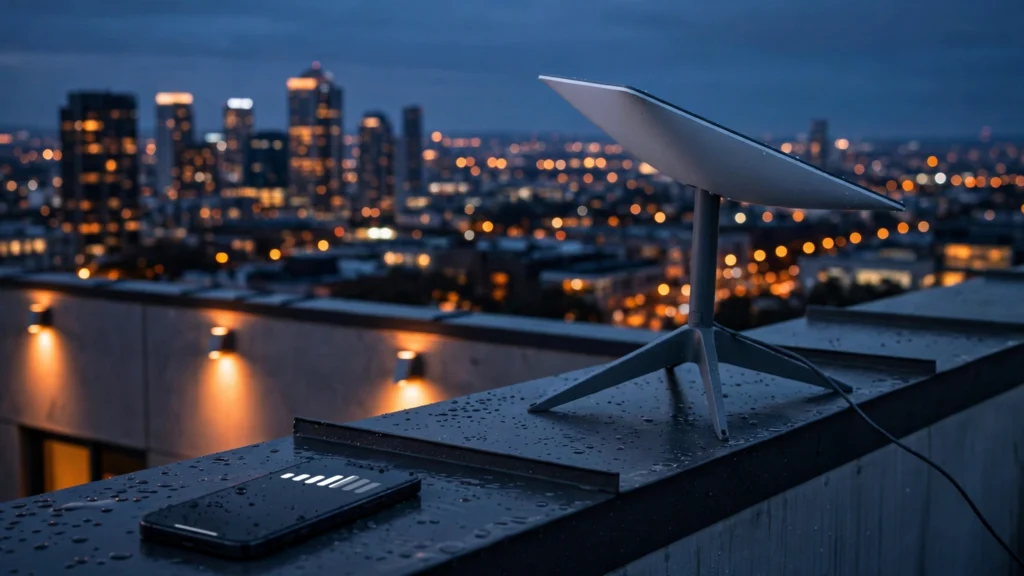
Because it tells you Starlink isn’t a side project anymore — it’s becoming a full phone carrier, and the dish business is the foundation it’s built on. Every new Starlink user still starts the same way: a dish on a roof, a cable running inside, a mount that holds up in bad weather. Phones don’t replace that. If anything, a bigger Starlink means more dishes, more installs, and more people finding out the hard way that the cable in the box is too short, or that their mount doesn’t fit the roof they actually have.
That’s the part we work on. We make the pieces that make a dish install actually work: Gen 3 replacement cables from 2 m up to 46 m, so you can put the dish where the sky is clear instead of where the cable runs out. USB-C and DC power cables for the Starlink Mini, for the car, the boat, the campsite. Roof, pole and suction-cup mounts for Mini and Gen 3 that are built for the job, not just for the product photo.
Starlink’s next chapter is phones. The current one still runs on dishes — and on getting the small parts right.
Browse our Starlink cables, starting with the Gen 3 replacement cable: https://www.fevelectronics.com/product-details/starlink-gen-3-replacement-cable/ — and if you’re setting up a dish somewhere unusual, tell us about it. We’ve probably made the cable for it.
