
Automotive HDMI Type-A to Type-E Cable
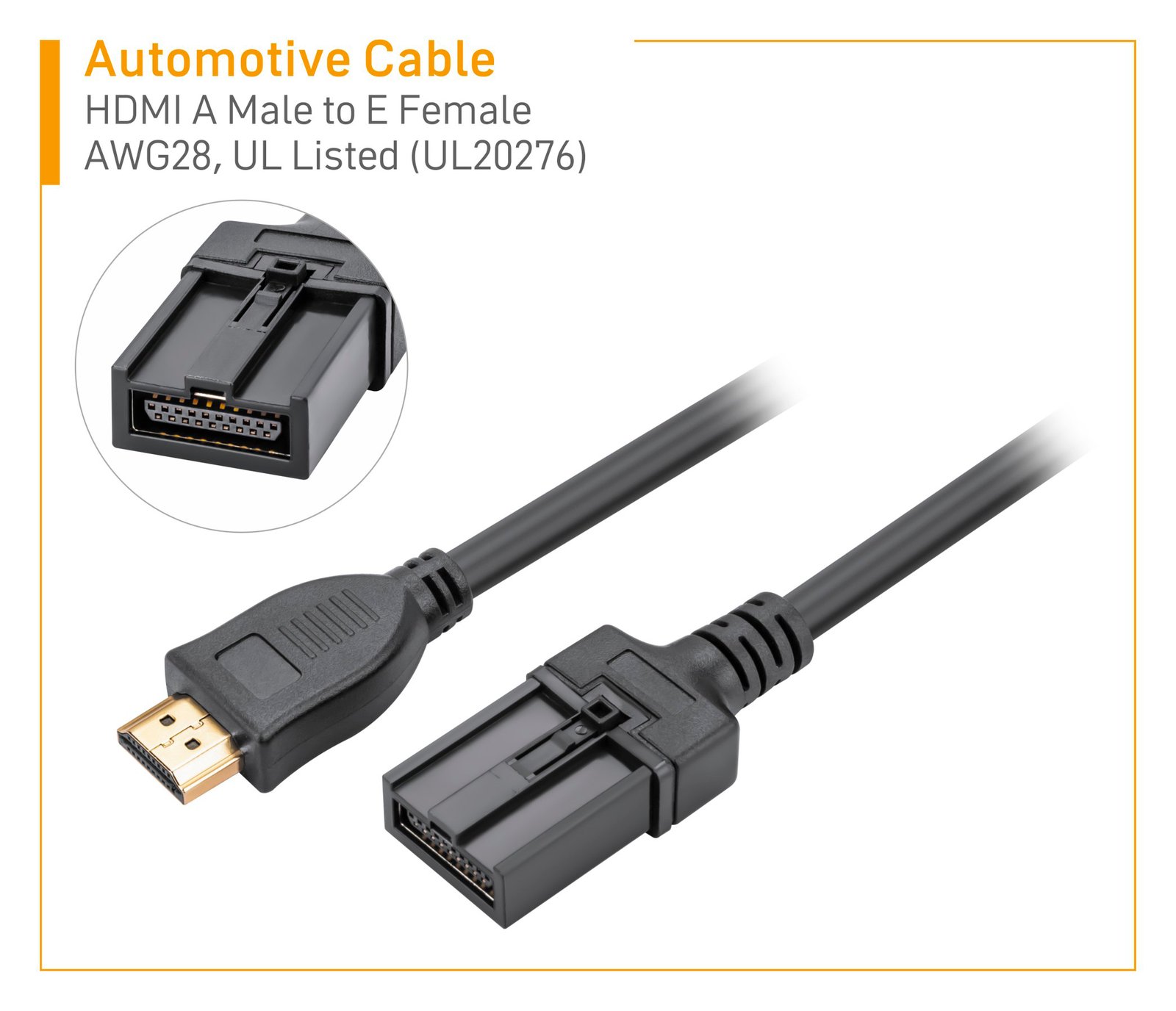
An HDMI cable built for the car, not the living room. One end is a standard gold HDMI Type-A plug; the other is an automotive Type-E socket with a locking latch, the kind that stays put when the car is moving. The Type-E end is shown twice in the photo — once on the cable and once in a close-up inset — so you can see the locking tab and the socket face before you order. It is a custom OEM configuration: length, pinout and labelling are specified to match the head unit or display it plugs into.
In a car, a normal HDMI plug is a loose end waiting to happen. The Type-E socket on this cable is the automotive answer: a bigger, latching housing that locks into its mating plug so vibration and movement do not walk it out. The photo shows the difference plainly — a familiar gold Type-A plug on one end, a chunky black Type-E socket with a locking tab on the other, with a close-up inset of the socket face.
The Type-A end goes to the source — a media player, head unit or other HDMI output — and the Type-E end takes the vehicle’s Type-E plug on the display side. No adapter stage in between, and no extra parts to lose behind the dash. The cable itself is black, with moulded strain relief at both ends.
On construction: the product card identifies the shown build as AWG28, UL Listed (UL20276). No resolution, bandwidth or refresh rate is stated for this cable anywhere in the source, and none is claimed here — the Type-E connector is a physical interface, not a promise about what resolution the finished install will carry. That depends on the source, the display and the ordered configuration, so confirm those before promising a customer a picture quality.
The honest way to order one is from a drawing or an approved sample. Connector keying and circuit mapping have to match the head unit and the display, and the length has to suit the routing through the vehicle. Share the mating connector references, the pinout, the length, the operating conditions and the quantity, and the pictured cable becomes an approved production specification.
Good for vehicle infotainment screens, rear-seat displays, diagnostic and amplifier systems, and OEM or replacement harness programs where an HDMI link has to survive inside a car.
Key facts / specs
- Connector configuration: HDMI Type-A plug (gold, visible in the photo) to automotive HDMI Type-E socket (black housing with locking latch, visible in the photo; socket face shown in a close-up inset)
- Purpose-built format for display and video connectivity without an extra adapter stage
- Wire: AWG28, UL Listed (UL20276) — as stated on the product card for the shown construction
- Black cable with moulded strain relief at both ends (visible in the photo)
- Custom length, pinout, labelling and packaging can be specified for production projects
- Length: not stated — confirm before ordering
- No resolution, bandwidth, refresh rate, power or ingress rating is stated; none is claimed
Compatibility
For vehicle infotainment and display systems with an HDMI Type-A source and an automotive HDMI Type-E connection on the display side. The mating connector references and pinout must be confirmed against the head unit and display — this is a made-to-order configuration. It is not a standard home HDMI cable, and the Type-E end will not plug into a normal HDMI socket.
Application scenarios
- Vehicle infotainment and control modules
- In-car and rear-seat display links
- Diagnostic, amplifier and retrofit systems
- OEM or replacement automotive harness programs
Links
- Browse the full range on the AOC HDMI cable overview page.
- Related published HDMI models: Detachable HDMI 2.1 Active Optical Cable for Conduit Installation, Classic Black 4K HDMI Active Optical Cable, Long-Distance HDMI Active Optical Cable Product Family, Detachable LC HDMI Fiber Optic Cable 4K@60Hz and MPO Detachable Pure Optical HDMI 2.1 Cable 8K.
- External: BH Cables — wall plate and cable manufacturer.