
Our Products – Grid Layout
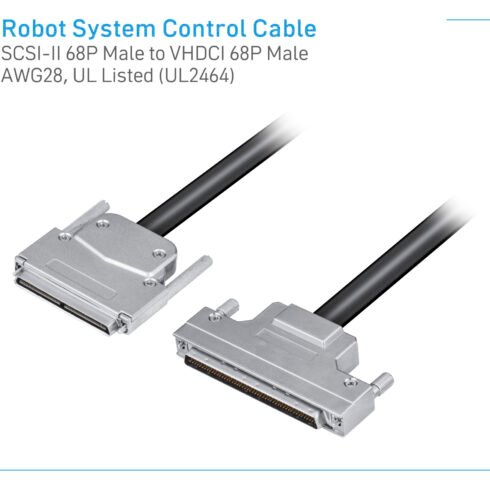
68-Pin SCSI-II to VHDCI Robot Control Cable
A 68-pin SCSI-II plug on one end and a 68-pin VHDCI plug on the other, both in metal shells with thumbscrews. This is the lead you need when one side of the link has a standard SCSI-II port and the other has a VHDCI port — same 68 pins, different connector, no adapter in between. The cable is a round black lead, and the gold contacts are visible in both connector faces.
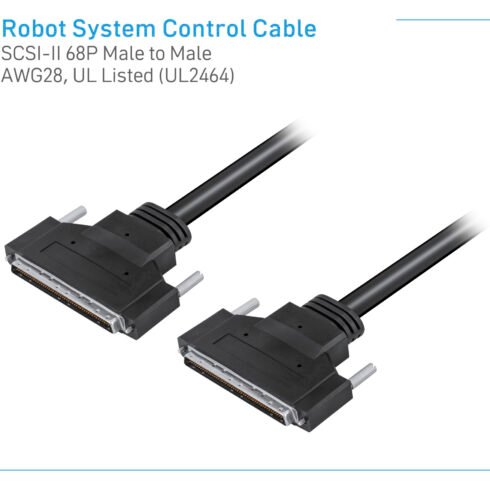
68-Pin SCSI-II Robot Control Cable
A 68-pin SCSI-II plug on both ends, in black moulded housings with metal thumbscrews. The cable is a round black lead with ribbed strain reliefs where it enters each housing, and the gold pins are visible in both connector faces. Straight plug-to-plug — the high-density link between a robot controller and the machine it drives.
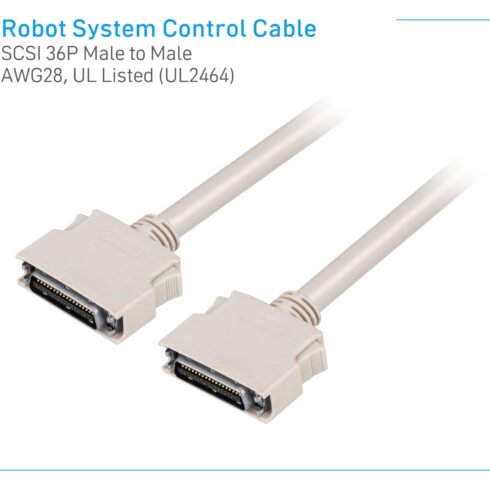
36-Pin SCSI Robot Control Cable
A 36-pin SCSI plug on both ends, in beige moulded housings with latch clips you squeeze to release. The cable is a light beige round lead with ribbed strain reliefs where it enters each housing, and the gold pins are visible in both connector faces. Straight plug-to-plug, no adapters — the kind of lead that lives between a robot controller and the machine it drives.
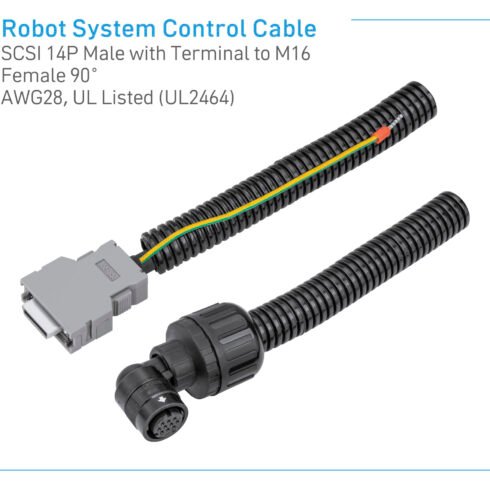
14-Pin SCSI to Right-Angle M16 Robot Control Cable
A 14-pin SCSI plug on one end and a right-angle M16 socket on the other, with the cable run protected by a black corrugated sleeve. The 90-degree bend at the M16 end is the point of this one: it lets the cable turn a tight corner right at the connector instead of sticking straight out of the port. The SCSI end is a grey moulded housing, and a green-and-yellow wire with an orange terminal runs alongside the sleeve.
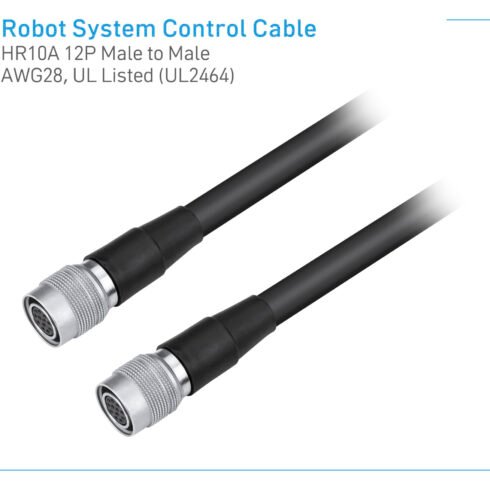
HR10A 12-Pin Robot Control Cable
A 12-pin HR10A cable with the same metal circular connector on both ends. Each end has a knurled coupling ring you tighten by hand, a black moulded strain relief, and a round black cable between them. It is a straight plug-to-plug lead for robot controllers and machine control — no adapters, no breakout, just the two connectors and the cable.
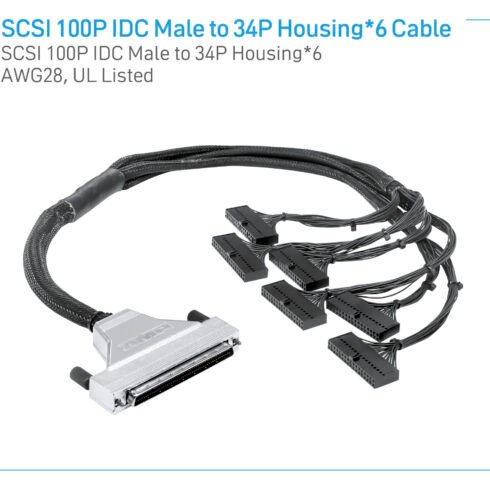
100-Pin SCSI IDC to Six 34-Pin Housing Cable
One 100-pin SCSI IDC plug in, six 34-pin housings out. This cable takes a single high-density SCSI interface and breaks it out into six separate 34-pin branches, each in a black plastic housing, so one port can feed several boards or modules inside a machine. The main run is wrapped in a black braided sleeve with heat-shrink at the split, and the SCSI end sits in a metal hood with thumbscrews.
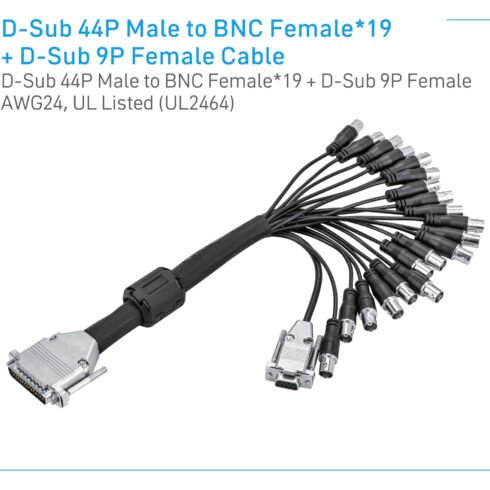
44-Pin D-Sub to 19 BNC and 9-Pin D-Sub Cable
One 44-pin D-Sub plug on one end, nineteen BNC sockets and a 9-pin D-Sub socket on the other. This fan-out cable turns a single high-density 44-pin port into a whole row of individual BNC connections plus one 9-pin serial-style port — the sort of lead you need when a test rig or controller has to break a multi-channel interface out to separate instruments. The main trunk has a ferrite sleeve on it, and the 44-pin end is a metal shell with thumbscrews.
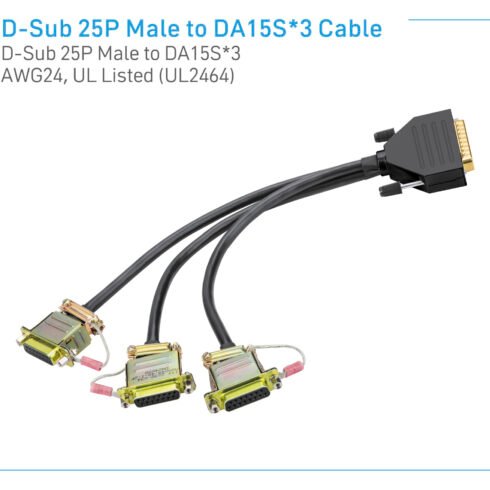
25-Pin D-Sub to Triple DA15S Breakout Cable
One 25-pin D-Sub plug in, three DA15S connectors out. This breakout cable takes a single 25-pin port and splits it into three separate 15-pin branches, so you can run three connections off one port without a tangle of adapters. The DA15S ends are metal-shell sockets with a small pink ring-terminal ground lead on each one, and the 25-pin end sits in a black moulded hood with thumbscrews.